the torch used in the hold-up
A Murder Is AnnouncedThe torch used in the hold-up appears to make the masked intruder visible, yet its dazzling, moving beam is also what frustrates observation. During the staged robbery at Little Paddocks, it commands the room and shapes what the witnesses think they saw; later, its path across faces, furniture, and a blank stretch of wall becomes a route back through their confused memories. Its role turns on a distinction between seeing a light and seeing clearly by it.
Appearance and Use in the Hold-Up
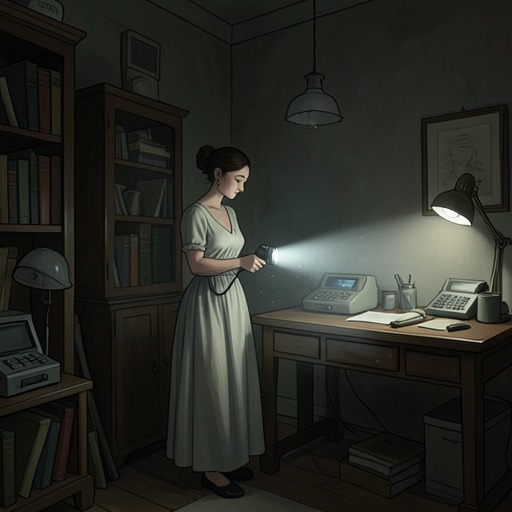
At Miss Hinchcliffe’s reconstruction, Miss Murgatroyd is given a trowel to stand in for the revolver and the torch to replay the intruder’s entrance. She is told to switch it on, raise it, and advance through the kitchen door as the burglar. The exercise makes the practical difficulty plain: she must manage a weapon-like object, the torch, and the door while performing the hold-up. As she turns the handle and steps forward, she transfers the torch from one hand to the other. Miss Hinchcliffe uses this awkward sequence to ask whether someone else could have held a door open for the intruder.
In the actual darkened room, the intruder shines the powerful torch on the witnesses. One describes the glare as horrible and dazzling, strong enough to make people blink. The accounts make the beam sound like a spotlight on the supposed robber, but the brightness does not produce reliable identification. The torch directs attention while at the same time impairing the room’s ability to see.
The Beam and the Problem of Testimony
The witnesses’ confidence that they saw a masked man with a revolver and a torch becomes a central problem for the investigation. Craddock recognizes that each person may have seen something different under intense excitement and nervous strain. When he argues that the witnesses all saw the intruder, Miss Marple gently challenges the premise: in the conditions described, they may not actually have been able to see anything at all. The torch’s presence is not proof that it illuminated the scene well enough for its occupants to observe it accurately.
The geometry of the room explains the difference. Miss Murgatroyd had been standing behind a door, facing the same way as the torch. The door screened her from looking directly into the beam, whereas the others were dazzled by it. Hinchcliffe draws out the consequence: while the room’s occupants blinked against the glare, Miss Murgatroyd may have been the only person with an unobstructed opportunity to see what the moving light revealed. The torch therefore divides the witnesses rather than giving them a common view.
Reconstructing the Route of the Light
Hinchcliffe’s reenactment also clarifies why the torch’s movement matters. Miss Murgatroyd recalls that the beam swung across faces, tables, and chairs. Pressed to attend to what it showed rather than to dismiss her own memory, she identifies Miss Bunner’s open mouth and staring eyes among the faces it picked out. This specific recollection gives the beam a sequence and direction: the torch did not simply illuminate a generic scene; it passed over particular people and objects.
Miss Marple later makes that sequence part of the solution. She compares memory under shock with the way a person may remember a conspicuous detail without consciously understanding its importance. Following the torch’s path in Miss Murgatroyd’s mind, she places its sweep near the mantelpiece, along the two windows, and past the people between them. The beam then crossed a blank wall and a table bearing a lamp and a cigarette-box. These details let the remembered light serve as a map of the room, rather than as confirmation of a clear view of the attacker.
What the Light Reveals—and Conceals
The decisive clue is not a face caught in the beam but the space it passed over. Miss Murgatroyd remembers the wall where the two bullet holes were later found: at the moment Letitia Blacklock was shot, Letitia was not standing in the place where the witnesses expected her to be. Miss Murgatroyd had initially struggled to make sense of the recollection; she remembered an empty place without immediately recognizing that its absence, rather than any person in it, was the significant fact.
That absence bears directly on the reconstruction of the attack. Hinchcliffe proposes that an accomplice could have used the oiled second door to slip out while the apparent robber attracted everyone’s attention with the torch and the hold-up. The torch helped occupy the witnesses, but its beam also made their different viewing positions consequential: the dazzled group could mistake a staged display for a complete account, while Miss Murgatroyd’s partial but less-blinded view retained the route to the missing figure. The object functions at once as a tool of misdirection and, through the particular traces of light it leaves in memory, as evidence against that misdirection.
Narrative Significance
The torch’s importance lies in the gap between an eyewitness claim and an actual observation. The witnesses remember the glare, the masked figure, and the apparent hold-up, but their shared impression does not mean they shared a clear sightline. Miss Murgatroyd, whose confused manner makes her testimony seem easy to discount, preserves a precise spatial memory when prompted to follow the beam rather than supply an interpretation. The story thus makes the torch both a practical instrument in the crime and a test of how perception, attention, and later recollection can diverge.
Its changing function also drives the disclosure. At first, the beam seems to support the intruder’s performance by dazzling the room and directing attention toward him. In reconstruction, it exposes the physical difficulty of handling the torch and a door at once. In Miss Murgatroyd’s recovered memory, its sweep records a sequence that leads to the unoccupied place where Letitia was expected. The same light that helps conceal the shooting from most witnesses ultimately helps make the concealed arrangement legible.